I'm a Londoner, and fell into feature film production in the 60's, more by accident than design. Being a very naive 18-year-old, I took the first job I was offered by the employment agency, and found myself at Columbia Pictures, in their Advertising Department. I didn't like it, but stayed for 2 years so I didn't look like a flake going forward, but my interest in filmmaking was piqued. I took an assistant job with a TV commercial production company and really enjoyed it. My first commercial was with George Lazenby, prior to his short stint as Bond, but then the director's assistant thought I had eyes on her boss, and got me fired. I didn't. I really liked the editor who ultimately turned out to be gay!
Then came a short stint in 1967 on Privilege starring Jean Shrimpton. I was a production assistant and so thrilled to have landed another gig. But sadly, when the crew moved to Birmingham in the north of England to complete filming, I was let go. Even though I understood the maxim, last on, first out, I was still distraught.
But the Associate Producer took pity on me and recommended me to an American producer, Herman Cohen. He was working out of Shepperton Studios on a film starring Joan Crawford. Ty Hardin and Diana Dors (for those who remember). By the time we wrapped, I was totally hooked, but again, out of work. I don't think there was anyone on the Shepperton Studios Lot who didn't know I was looking for another gig.
But fortune smiled once again. Another producer at Shepperton was looking for an assistant. John Dark was Executive Producer on the Tommy Steele movie Half a Sixpence and I joined him a week later. We were crazy busy, as he was also wrapping post production on the original Casino Royale movie.
Then Paramount asked John to produce Roman Holiday to be shot in Rome with Franco Zeffirelli and starring Robert Redford. John asked if I would like to continue working with him, and be his assistant on it.
I was beyond excited. But my first task was to accompany his personal car, a Humber Hawk, to Rome. No, I didn't drive it, but watched it being put on the ferry in Dover, and driven off in Calais, where I was met by John's new Italian driver and driven to Rome.
John had rented a beautiful villa on Via Appia Antica, a little way out of Rome, and I was able to stay and work from there while the final decisions regarding studio, were being worked out. We even visited the large Dino De Laurentis Studios where Jane Fonda was wrapping up on Barbarella. And then, as happens so often, there was a disagreement between the powers that be on Roman Holiday, and the movie was cancelled. I was obviously devastated... but
When one door closes, another opens, and this was immediately the case. Another Paramount picture, The Adventurers, was filming in Paris but had to leave because of the 1968 student riots. Rome suited the storyline and the producers relocated the picture. And, joy of joys, I knew the Executive Producer, Paul Hitchcock, from my days on Half a Sixpence. He asked if I would like to stay on in Rome and work on the incoming movie.
I did not need to be asked twice, and John understood. So, I rented an apartment near the Spanish Steps, bought an Austin Healey Sprite, a little English sports car still with right hand drive, and quickly adopted the crazy way Italians drive. I learned how to drink and appreciate Espresso coffee, and work, what were called, French hours. I took to them like a duck to water and especially enjoyed the long lunches with the Italian crew, at different restaurants, each day. The 9am to 1pm, 4pm to 8pm, definitely worked for me.
My Italian was beginning to improve, but two months later the production was scheduled to relocate to Bogota, Colombia, to complete filming. But my boss, an accountant, never went in to bat for me, to also be able to go. I waited and waited, and finally a week out, I could wait no longer. I went in to see Geoff Helman, the Production Manager, by myself, and as I was about to plead my case, Victor Lindon, the Associate Producer, walked past the open office door. Geoff called out. "Are we taking, Rosemary?" Victor looked at me, back at Geoff, shrugged his shoulders and said, "I suppose so." I was out the door before either of them could change their minds. I did know it was no big deal regarding travel and money, as Paramount had chartered a plane to carry the entire 80-man crew and equipment and they would have had to pay someone there anyway, to do my job.
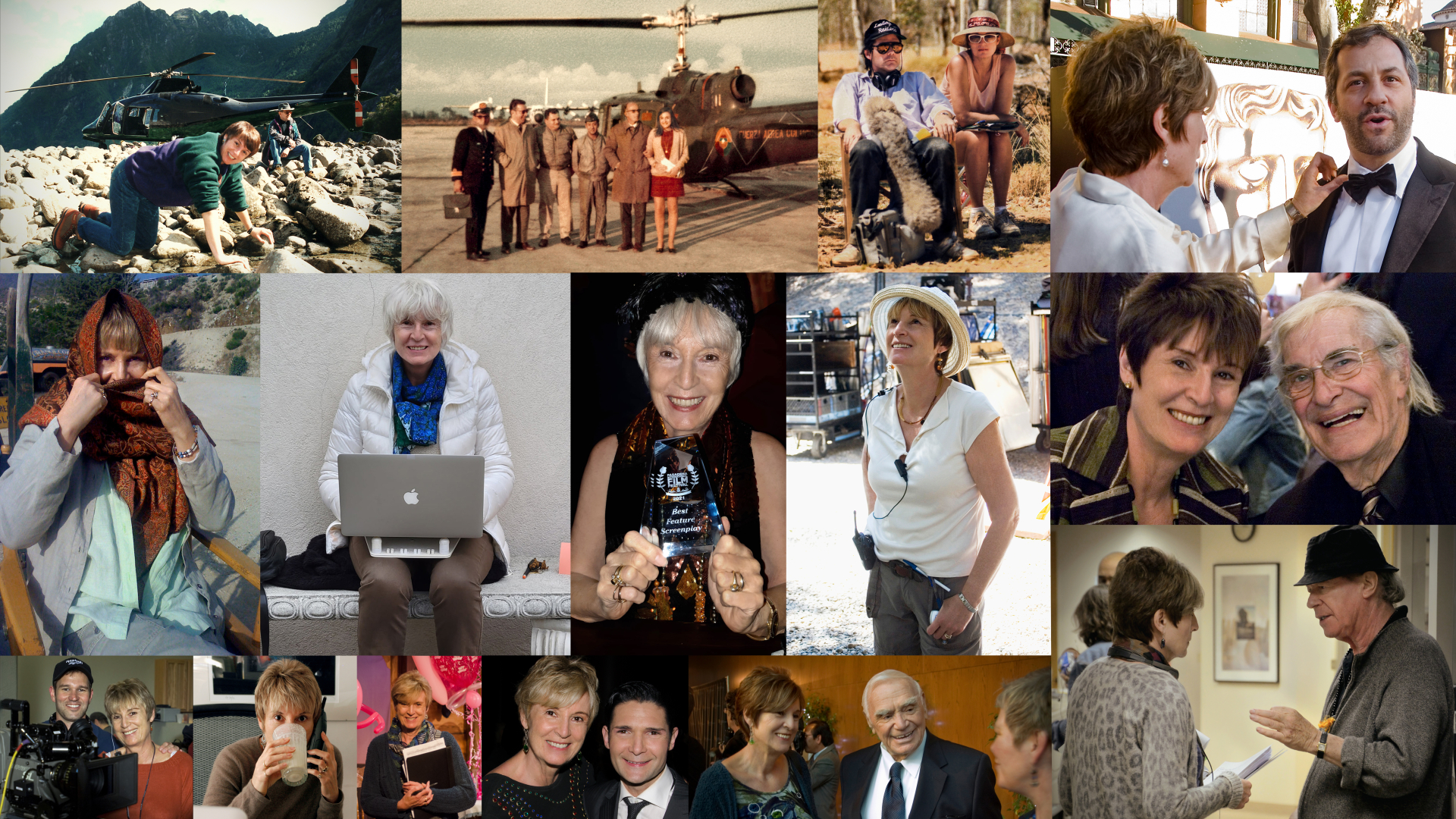
I was 22, it was 1968 and what a great adventure. Apart from being able to see much of the country, I got an in-depth schooling, in Overseas Location Filming 101, from our extraordinarily talented crew for which I am eternally grateful. One day we were scheduled to film a complicated stunt with a runaway locomotive and carriages, at a remote location. I asked our Geoff if I could also go and watch, as he was travelling there by helicopter. He agreed. I watched the stunt, that went spectacularly wrong, but so right for the movie, and no one was hurt. I travelled back to the local airport to get a ride back to Bogota, but Geoff had other people who needed to go, so there was no room on the chopper. He said he would work something out to get me back later, and took off. I had no idea what to do. I watched a very large helicopter land, and important looking men head to a conference room in the terminal. When I asked who they were, I was told it was the Colombian Minister for Health, and officials, who had come for a meeting from Bogota. I asked if they were flying back there, and might there be a possibility I could hitch a ride. The airport manager spoke to them at the end of their meeting, and the Minister was only too happy to give a stranded young, English young lady a lift. I still have a photo of me with him and his men, in front of the military chopper on the tarmac. Geoff never enquired how I got back!
In the summer of '69, Barrie Melrose, one of the production managers on Casino Royale, asked me to be his production coordinator on a Roman Polanski movie that was to be directed by Simon Hesera, a French director, and protege of his. It was set in Denmark, and while the experience of filming, and living, in Copenhagen was unforgettable, it was sometimes hard to forget the pain and anguish Roman Polanski himself must have been going through on the death of his wife. The film starred Peter Sellers, who always called me Roses, and his presence throughout production was a great morale booster for the crew.
In the latter part of the same year, Barrie invited me to coordinate his next project to be filmed in Dublin, Ireland. It was entitled Quackser Fortune Has A Cousin in the Bronx and starred Gene Wilder, with Margot Kidder in her first movie role. I rented a cottage on a farm outside Dublin, not far from the Studio, and got used to waking up with the sound of cows mooing outside my front door. The script was fun and we made a good movie but sadly it did not resonate with audiences.
In 1970, John Dark asked me back to work as his assistant again. This time on There's A Girl in my Soup, starring Peter Sellars and Goldie Hawn. It got nominated for a BAFTA Award. Our two stars were often hilarious, sometimes reducing the crew to tears of smothered laughter. It was a fun show.
Later that year I was asked if I would like to work with George Cukor who had come to London to set up a film with Katharine Hepburn. I can remember feeling what a great honour that was, and really enjoyed working with him for a month before fate stepped in and the film was pulled from the roster. However, the highlight of those 4 weeks was being able to accompany Miss Hepburn on her morning walks in Hyde Park.
Then 1971 brought The Public Eye, again as Production Co-Ordinator. Carole Reed was our director and had assembled a talented crew. I made some good long-time friends and worked with many of them on subsequent projects. Hal Wallis was one, who employed me on Mary Queen of Scots where I met Charles Jarrott, the director of that film. He wrote to me, out of the blue, sometime later, and asked me to be his assistant on The Dove.
1972: The Nelson Affair, a Hal Wallis movie and I was his assistant. It was directed by James Cellan Jones and starred Glenda Jackson, Peter Finch and Anthony Quayle. I always felt very privileged to be working with such luminaries of the film industry and learned much.
1973: Charles Jarrott, director, had sent me a letter to ask if I would like to be his assistant on The Dove that was to be produced by Gregory Peck. This was a true story of a boy who sailed around the world and starred Joe Bottoms and Deborah Raffin. How could I say no to Los Angeles, Australia, Fiji, the Solomon Islands, the Galapagos, Panama, and Mozambique. We had an extraordinary crew that included Chris Challis, DP, Anne Coates, Editor, Terry Marsh, Designer, and Julie Harris, Costume Designer, all of whom I had worked with before. My first job, when we finally reached Fiji after a 4-week prep in Los Angeles (my first time there), was to fly to the Solomon Islands with the Location Manager, and while he was scouting, I had to prepare a selection of male and female Solomon Islanders who were to be used in the film as extras. Our stay was memorable, not because I completed my task, but because I walked on the beaches of Guadalcanal and picked up a shell casing from WWII. It was an eerie experience to imagine the slaughter that had gone on there.
In 1974, Barrie Melrose invited me to be his Production Coordinator once again. This time on Juggernaut, a Richard Lester directed movie. It had a stellar cast, including Richard Harris, Omar Sharif, David Hemmings and Anthony Hopkins. Half of the story was set on a military ship. This necessitated the entire film crew to be housed on a cruise ship, for 10 days in the North Atlantic, in order to capture, gale force winds, huge seas and storms! No CGI in those days. What we didn't realize was that the cruise ship, the company had rented, and been a Russian cruise ship and the Russian crew had to sail with us because they had to teach the British crew everything about the ship. Not always to great effect, as on the day the British crew accidentally tipped a huge container of oil all over one side of the ship and then had to spend two days trying to clean it. However, the upside of it being a Russian ship was that the food had a Russian bias, with great caviar at every meal.
A piece of the storyline was a bomb had been planted on board and it was a race against time to get it diffused and save all the passengers. My mum had recently died and I wanted to help my father take his mind off her death, so I asked Richard if he would consider using him as an extra. In his younger days my dad was the spitting image of Clark Gable and I had also been getting him some extra work, even though he was now 79. Richard gallantly agreed. So, my father and I were able to spend 10 days at sea together, and he got a walk on part, you can still see in the movie today, as a passenger exercising his dog on a rolling deck!
1975-1976: I was invited by Ivor Powell, who was a Location Manager on The Adventurers and now one of Ridley Scott's producers at RSA Productions in Soho, to join Ridley's company. It was a TV commercial company and a new director had joined, Hugh Hudson, but there was no one to produce for him. I was thrown in the deep end and really enjoyed my two years with RSA, where I learned much about TV commercial production, not realizing it would stand me in good stead down the track.
1977: I was invited to visit and stay in Wellington, New Zealand, by a recent boyfriend. I left my flat in London in the capable hands of my sister, with whom I'd been sharing, and took off. Footnote: I never lived in England again. A camera rental company in London, had recommended I look up New Zealand TV commercials director, Geoff Dixon, in Wellington, as I might be able to get some freelance work from him. I called soon after I arrived, and was quite taken aback when I introduced myself. On hearing my name the receptionist responded, "Oh good. We were wondering when you were going to get here." Unbeknownst to me one of the guys from Samuelsons, the rental company, had told them a London commercial producer was coming there to live. You could have knocked me down with a feather. Geoff was a delight to work with and I below saw much of the beautiful country. However, after a year, and after the bank turned down a request from my boyfriend and I for a mortgage, plus reading the local council had refused a licence to a start-up Mexican company to import tortillas, because there was no call for them, we decided it was time to move to Sydney.
1978: It's April, and as we fly over Sydney Harbour Bridge and the blue water, I think to myself, "This will do." A week later I walk into the Sydney Immigration office and say I would like a temporary residence permit. The official sitting opposite me says, "How long will you be here?" I say, "I don't have any plans to leave right now." and he says, "Then you need a permanent resident permit." I agreed and he asked me a whole bunch of questions, one of which was, "Could I do shorthand and typing?" I grinned and told him I could because it was totally true and he responded, "Then we'll put you down as a stenographer. We're short on those." It took all my willpower not to laugh, but I walked away with my permanent resident permit. Three years later I became a citizen after Australia had passed a law allowing foreign nationals to hold two passports.
1978-1980: I knew no-one there in the film industry, so went to see Dennis Everingham, the Creative Director at Grey Advertising, with a view to asking advice on how to capitalize on my TV commercial skills. We talked for a bit and then he offered me the job of Head of Broadcast for Grey, to oversee all their TV commercial production! What could I say! However, they didn't produce many commercials a month and I was a bit bored. I went to see the head of finances with a proposition. I'd take a fifty percent cut in my wages if they let me free-lance for other companies. I think they were too taken aback to say no and my income suddenly expanded as i worked with many of the other advertising agencies.
1981-1983: I started to feel something was missing in my life and decided to opt for a change of pace. An English girlfriend of mine suggested I move to Townsville in Far North Queensland, where she and her husband and children lived. The change was good, but for the first time in my life I made a bad choice when I agreed to go into the restaurant business with two friends who also knew nothing about that world. If I had had any sense, I would have pulled out after opening day. Our chef was late and when I sent someone to find him, they found him dead in his bed. An omen I should have recognized, but I tried to make it work for two years but then returned to Sydney. However, during my time up there, I fell in love with the tropics and especially a tiny village called Kuranda, high on the range above Cairns.
1984-1988: Back in Sydney I knew I had made the right choice to return because, nearly immediately, I was offered a co-Head of Broadcast position at the Campaign Palace, the most creative commercial house there. I shared the title with a lovely lady, Lois McKenzie, and we went on to produce many award-winning commercials for the Palace.
One day, out of the blue, I received a surprise phone call from Paul Hitchcock, who was now a Chief Executive at Warner Bros. He told me Terry Semel, head of Warners USA, had asked him to come to Australia to check out the film studios on the Gold Coast, as Warner Bros. was considering buying them. I thought that was pretty cool and he asked if I would like to go with him. It is amazing seeing them now, knowing what they were like back then. This story is not over. Six months later I received another phone call from another old London friend, Stanley O'Toole, who was one of Paul's best mates. I was surprised to hear from him and even more surprised when he told me Paul had asked him to come and run the Warner Bros. Studios on the coast, because he didn't want to.
1989-1992: Stanley asked me if I would like to work on a Tom Selleck movie he was producing in the middle of Australia. This was Quigley Down Under to be shot in Alice Springs. Of course, I said yes. The rest is nearly history, because the editor on the movie, Adrian Carr, and I fell in love, and got married in 1991. However, when we first met I had mentioned to Adrian, that Quigley was going to be my last job in the film industry as I had bought a large acreage in Kuranda, and was going to live there. His response was, "I don't think so." We moved to Los Angeles, in 1992!
1992-2023: Changing countries was a major challenge, no-one was interested in my experience and previous work because, if there is not a local production job on your resume, nobody cares. This was the same for Adrian. However, we both survived and lived to tell the tale. I have produced, line produced, supervised and worked as producer, production manager and a key location manager on many, many productions large and small. They are all listed on my resume, but one in particular I'm particularly proud of, is being the Co-Producer of Thirteen with Holly Hunter. I also had the good fortune to produce nine movies for Los Angeles auteur director, Henry Jaglom. The first, as his Production Manager, was Festival in Cannes, that starred, among others, Anouk Aimee, Greta Scacchi, Maximilian Schell and Ron Silver. We shot at the 2000 Cannes Festival for 7 days with a crew of 10! It was an exhilarating experience.
2024: Now it was time to leave America so I could live my dream of building a home in Kuranda, where I had been headed in 1989. Adrian agreed it was time for us to settle somewhere that would be our forever home, and what better place than the stunning rainforest region of Far North Queensland. I hasten to add this is not to retire, but to recoup. Over the years we have developed many, many screenplays, learned how to recognize good writing, structure and story-telling. and now we have time to pursue funding for many of them, through our attorney in Los Angeles and Adrian's agent in Sydney.
2026: A new chapter waiting to be written.